
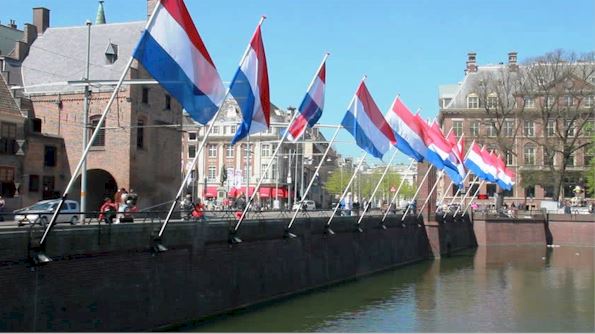
Liberation Day – The Netherlands
Today, May 5th, is National Liberation Day in the Netherlands to commemorate the capitulation of the Nazi forces in that country exactly 70 years ago on May 5, 1945. It is a national holiday, although not a statutory day off and employers are allowed to work this out between themselves and their employees.
As someone born in the Netherlands at the beginning of WWII I remain deeply grateful for the fact that Americans and Canadians came over to slay the evil Nazi beast and set us free. Many of them gave their lives for this. This surely was a case of a just war, wasn’t it: the grim and sadistic Nazi machine had to be stopped and sent back down the gates of hell from whence it came, goose-stepping and all. So many innocent people died as a result of this war, on both sides.
It wasn’t until much later that I heard about the Allied bombing of civilian targets, and in particular the firebombing of the city of Dresden when the Nazi Reich was already well on its knees, with the Germans surrendering less than a month later on May 7, 1945, following Adolf Hitler’s suicide and the Soviet troops conquering Berlin.
On the night of February 13, the British Bomber Command hit Dresden with an 800-bomber air raid, dropping some 2,700 tons of bombs, including large numbers of incendiaries. Aided by weather conditions, a firestorm developed, incinerating tens of thousands of people. The temperature of the masonry in the city’s cathedral reached an estimated 1,000 Celsius. Reports speak of many victims melting in the intense heat, their bodies becoming welded to pavements. The U.S. Eighth Air Force followed the next day with another 400 tons of bombs and carried out yet another raid by 210 bombers on February 15. (*)

The Dead of Dresden
It is thought that some 25,000–35,000 civilians died in Dresden in the air attacks, though some estimates are as high as 250,000, given the influx of undocumented refugees that had fled to Dresden from the Eastern Front, primarily from Silesia and on the run from Stalin and the Red Army. Most of the victims were women, children, and the elderly.
Dresden was just one of a number of German cities that were targets of aerial bombing raids as Hamburg and Königsberg suffered similar fates. However, the seemingly indiscriminate large-scale area bombing of civilian populations remained controversial throughout WWII. Winston Churchill went so far as to write “The destruction of Dresden remains a serious query against the conduct of Allied bombing.” While there were legitimate military targets in Dresden, how can one sanction the deliberate targeting of the civilian population?”
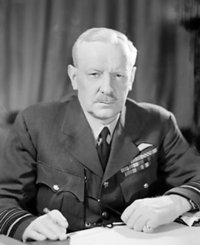
Arthur “Bomber” Harris
The British air attacks were conducted under the leadership of Air Officer Commander-in-Chief Arthur “Bomber” Harris, and when questioned about his preference for area bombing over precision targeting given the large number of civilian casualties and wide-scale destruction the strategy caused he is reported to have said:
“It should be emphasized that the destruction of houses, public utilities, transport and lives, the creation of a refugee problem on an unprecedented scale, and the breakdown of morale both at home and at the battle fronts by fear of extended and intensified bombing, are accepted and intended aims of our bombing policy. They are not by-products of attempts to hit factories”. (RAF Air Chief Marshal Arthur Harris, October, 1943) (**)
The issue was raised within the British House of Lords on Wednesday February 9th of 1944, when it was pointed out that this practice would have been contrary to International Law, as per the 1922 Washington Conference on Limitation of Armaments proposed code for Aerial Warfare.
While this code did not become an international convention, nevertheless great weight should be attached to article 22nd drawn up by a Commission of International Jurists: “Aerial bombardment for the purpose of terrorizing the civilian population, of destroying or damaging property not of military character, or of injuring non-combatants is prohibited”. As well, Article 24 stated: Aerial bombardment is legitimate only when directed at a military objective.
In this this context the British historian Frederic Taylor said that , while it was true that Dresden as a major German industrial and military centre was a legitimate target for the Allied Forces to go after, “When we think of Dresden, we wrestle with the limits of what is permissible, even in the best of causes.”
(*) In describing the RAF bombing of Dresden and other German cities during WWII, I wish to make it absolutely clear that anyone who gave their life in WWII to eradicate the criminal Nazi regime deserves our deepest appreciation, and their acts of bravery and self-sacrifice should never be forgotten. And this includes the thousands of US and British airmen who were ordered to perform incredible feats of courage, by flying nearly blind for hours and hours in the dark across hostile territory and aided by relatively limited navigational aids – at least by today’s standards)
(**) In defending his role in the fire-bombing of Dresden Harris wrote that “… the attack on Dresden was at the time considered a military necessity by much more important people than myself.” Bomber Command’s crews were denied a separate campaign medal (despite being eligible for the Air Crew Europe Star and France and Germany Star) and, in protest at this establishment snub to his men, Harris refused a peerage in 1946; he was the sole commander-in-chief not to become a peer. However, in February 1953 Winston Churchill, now prime minister again, insisted that Harris accept a baronetcy and he became baronet.