
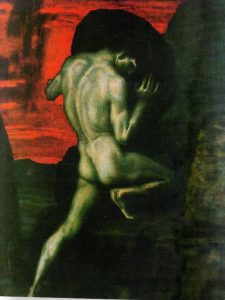
Sisyphus – by Franz von Stuck
Sisyphus, as we know, is the figure in Greek mythology who was punished by the local Gods for his deceitfulness by being forced to roll an immense boulder up a hill, only for it to roll down again at the top, forcing him to repeat this action for eternity.
In The Myth of Sisyphus published in 1942 French author and Nobel laureate Albert Camus retells the tale of Sisyphus as likening the futility of his labours to the human condition, the point being that all human endeavours are essentially meaningless in a cold and indifferent universe.
Camus concludes that it is absurd to continually seek meaning in life when there is none, and that it is equally absurd to try to know, understand, or explain the world when no rational knowledge can be obtained from it. While accepting absurdity as the mood of the times, Camus appears most interested in the question of whether or how to live in the face of it.
But there is a problem this line of reasoning, and not only on just logical grounds. Firstly, we can’t exclude the possibility that there is in fact a meaning and purpose to the universe just because we can’t see the point of it.
Secondly, it makes no sense to say that we cannot obtain rational knowledge of the world given the multitude of verifiable scientific successes that have occupied themselves with the material nature of the world. This includes the discovery of evolution as a means to provide perspective to the phenomenon that live represents as well as the context for where we are in the in the hierarchy of all things living.
And by linking our biological ancestry to the heart of the material universe through the process of evolution, science has attached us more firmly to the world.
This leads me to believe that the universe has a plan, and within it lies the larger context for all human endeavours, as we find ourselves at the receiving end of it. For many this larger context simply may not exist or is merely taken for granted, its relevancy subsumed in the background noise of every day life.
Other than that, yes, the story the greater universe may have to tell is definitely something of interest to science, but by and large their observations and subsequent theories put it so far out of reach of everyday life that it is difficult to see how much of it has any bearing on the way we conduct our lives.
One might presume that merely living our lives provides us with all the meaning and context we find ourselves preoccupied with at a given moment. But that might only be the case so long as we don’t look beyond the immediacy of the current moment and try to place it within the larger reality of the surrounding universe. And just because it is seemingly so grand and perplexing that we can’t possibly get our heads around it, it is nevertheless part and parcel of who and what we are, yet have absolutely no clue what we all of this means.